I ran across this story a while ago, and it’s too good not to share. Hold fast, friends; this is quite a ride.
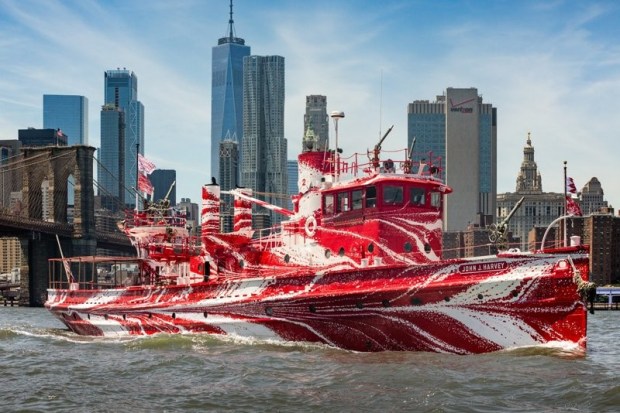
The John J. Harvey, shown here, is a museum ship now. For a nominal fee, you can book an excursion trip on her and experience how she rides. It’s worth the price of admission, even if she’s no longer painted in dazzle camouflage these days. (Presumably, it was so fire couldn’t find her.)
So why should you be interested? Well, I’ll tell you.
Every story begins somewhere. This one, I figure, should properly start with the man himself, John J. Harvey. Firefighter John J. Harvey was pilot of the steam fireboat Thomas Willett, assigned to Engine Co. 86 at Bloomfield Street in lower Manhattan. (Willett, I don’t know. Probably some ward-heeler or other. Oh, the first mayor of New York? You don’t say…)
On February 11, 1930 a fire broke out in a cargo hold aboard the North German Lloyd Lines ship Muenchen. Despite the valiant efforts of several crews, including that of the Willett, the fires couldn’t be contained and several explosions occurred. One sent a plate of sheet steel flying into the pilothouse of the Willett, killing Harvey instantly.
It’s a dangerous job, friends.

At the time, the next replacement ship for the antiquated fleet of steam fireboats was already under construction, a high-powered vessel with internal combustion engines. Immediately after Harvey’s death, the new ship was named for him. She launched on October 6, 1931 and placed in commission on December 17.
The John J. Harvey is 130′ long with a 28′ beam and 9′ draft, of steel construction with a riveted hull. Propulsion is by twin screws six feet in diameter. She was the largest and most powerful fireboat in the world when built. Harvey’s design was the model of modern fireboat engineering, and set the pattern going forward even into the new century. She was the fastest and most powerful of FDNY’s fleet, and could hit 20 knots easily.
Harvey’s long service saw her in harm’s way at fires and disasters ranging from the five-alarm that ended with the destruction of Cunard’s Pier 54 at West 14th Street in May 1932 to the sinking of the Normandie in 1942.
Ever hear of the Halifax explosion in 1914? An ammunition ship, the SS Mont Blanc, went up that took out most of the harbor and much of the city in the largest man-made explosion of its day. What you probably haven’t heard about was the El Estero, which was a lot bigger. The main reason you never heard about it was due to the heroic efforts of the Harvey and Fire Fighter, which pumped her full of water and sank her before the boiler fire could reach the ammunition hold and take out most of Manhattan.
(Also, they censored the story. Fear the public might panic, that sort of thing.)
Fast forward to 1995. The Harvey was removed from service in favor of more modern boats, largely due to the reduced number of large waterfront fires. New York isn’t the port it once was. She was put up for auction in 1999 after four years of neglect, and it was expected she’d go for scrap.
Then, a miracle happened — like most such, a miracle of hard work and lots of money. A private trust purchased and restored the John J. Harvey as a museum ship, and she’s now docked at Pier 66 on the West Side and, as I mentioned, gives excursion rides to this day.
But the Harvey‘s days of heroics weren’t over yet.
On September 11, 2001, when the World Trade Center was hit, several of the museum ship’s volunteer crew assembled and took her south to help with the Manhattan Boat Lift, helping to evacuate hundreds of people trapped by the disaster. While she was under way, FDNY contacted Harvey to ask if her pumps were working. They were. The water supply from the north had been crushed, and hydrants weren’t working south of the tower site. Harvey was redesignated Marine Company 2 and returned to service, pumping water at the seawall.

Countless friends and supporters, too many to name, used Harvey as their base of operations during the ensuing days, volunteering to help with supplies, rescue efforts, and clean-up in the subsequent days.
Since then, the John J. Harvey has returned to the quiet life of a museum ship.
Well. Not always quiet, per se. In 2018, she was painted with dazzle camouflage as part of a public artwork, for instance. That’s on the top picture.
The John J. Harvey is kept afloat by donations and the efforts of countless volunteers. If you’re interested in helping them with their work, the official website is: https://1931fireboat.org/index.php
CREDITS: Most of the wonderful photos were retrieved and copied from the foundation website. Thanks also to Wikipedia and “Curbed”. Inspiration comes from the delightful work of @TheDreadShips on TwiX, and our thanks are always there for the courageous men and women of FDNY’s Marine Division.
You can send cash to PayPal in order to help support The Not Fake News, set up a subscription donation at Patreon, or buy me a coffee. If you’re into Crypto, I’ll also happily accept DogeCoin, and in fact heartily recommend it since the fees involved are vanishingly small. I mean tiny. Sing out if you want to learn more.
Any complaints about the factual or humorous quality of this article should be written in pencil on the back of a $20 bill and mailed to us at the usual address. Feel free to use more than one twenty if you’re feeling verbose.

 The Not Fake News